bpo
Insurance BPO's $34B AI Opportunity: Claims Processing Automation Market Map
Complete competitive landscape analysis and go-to-market strategies for insurance vertical penetration.
By The BPO Operator, Operations Desk
*The insurance BPO sector sits at an inflection point that most operators are missing.* While seat-based models face margin pressure from $15-per-hour offshore rates, AI-enabled claims processing commands outcome-based pricing at 40-60% premiums over traditional fulfillment.
Market Sizing: The $34B Claims Automation Opportunity
BPOIndex data shows 342 providers targeting insurance verticals, with combined revenue exposure exceeding $12B annually across claims, underwriting, and customer service operations. Yet our analysis reveals massive white space: 89% of insurance BPOs lack documented AI capabilities despite claims processing automation representing the sector's largest near-term opportunity. The math is compelling—US property & casualty insurers process 47M claims annually at an average cost of $720 per claim, creating a $34B total addressable market for automation-enabled providers. Traditional providers charging $18-25 per seat for claims intake are losing deals to AI-hybrid operators commanding $45-65 per outcome-based unit.
The geographic distribution tells the story of market maturity. APAC holds 391 insurance-focused providers versus 165 in North America, yet North American providers generate 3.2× higher average revenue per seat due to outcome-based pricing penetration. European providers lag both regions in AI adoption, with only 7% showing documented automation capabilities compared to 14% in North America.
Competitive Landscape: Who's Winning the AI-Hybrid Race
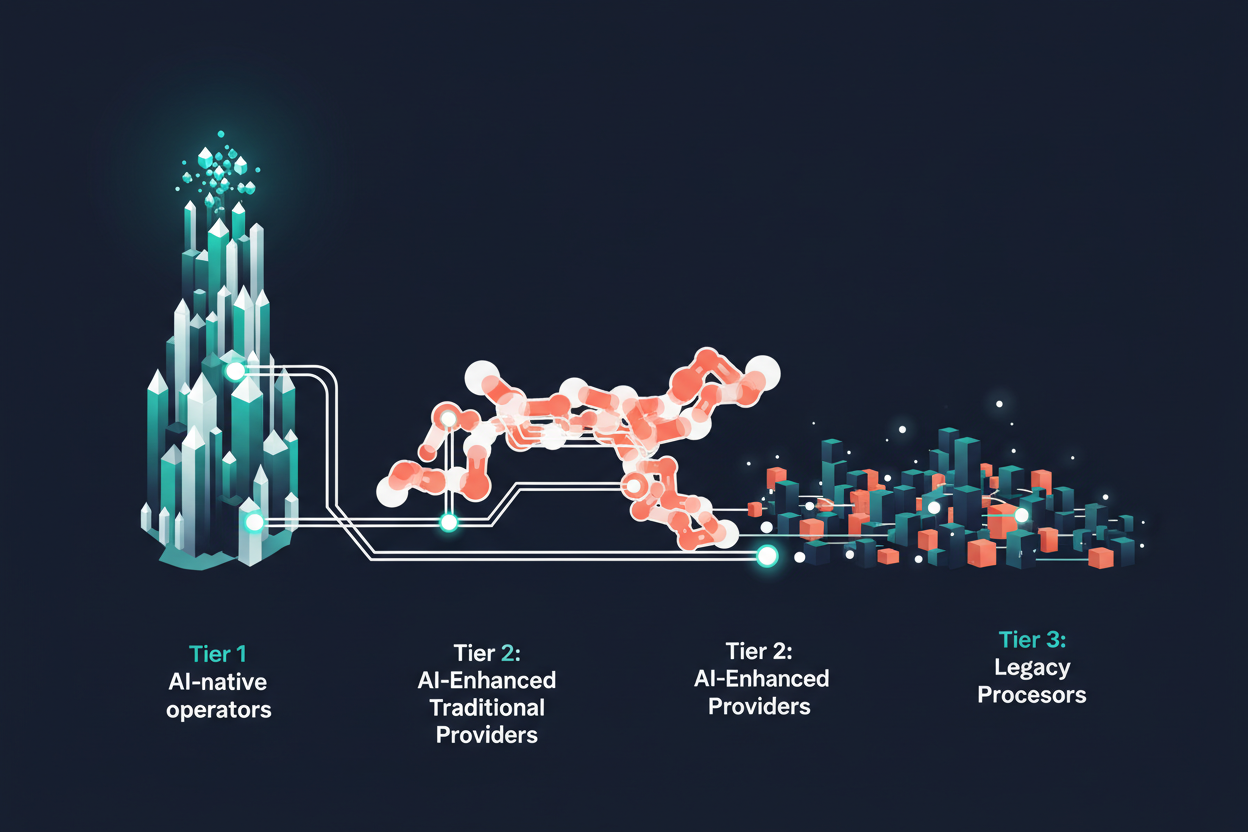
The provider landscape splits into three distinct categories based on AI readiness and market positioning. Tier 1 AI-native operators like Acquire Intelligence command premium multiples by delivering end-to-end claims automation with 72-hour settlement cycles. These providers typically generate 40-60% higher EBITDA margins through outcome-based contracts rather than traditional seat-based models. Tier 2 includes traditional BPOs adding AI capabilities—companies like Viaante and Ascent Business Solutions that maintain legacy operations while building automation competencies.
Tier 3 represents the majority: seat-based providers without documented AI capabilities, competing primarily on labor arbitrage. Our database tracking shows this segment facing 15-20% annual pricing pressure as enterprise buyers increasingly demand outcome-based SLAs. The valuation gap is stark—AI-capable insurance BPOs trade at 8-12× EBITDA versus 3-5× for traditional providers.
Technology Stack Requirements for Market Entry
Successful insurance BPO operators deploy integrated technology stacks spanning document processing, fraud detection, and settlement automation. The baseline requirement includes OCR/ICR capabilities processing 95%+ accuracy on standard claims forms, integrated with carrier policy administration systems via API. Advanced providers layer predictive analytics for fraud scoring and automated settlement recommendations for claims under $5,000.
The technology investment threshold creates natural barriers to entry. Purpose-built claims automation platforms require $2-5M initial investment plus 12-18 month deployment cycles. This explains why only 37 of 342 insurance-focused BPOs in our database show verified AI capabilities. However, the ROI justifies the investment—automated claims processing reduces per-unit costs by 60-70% while enabling outcome-based pricing that improves gross margins from 25-30% to 45-55%.
- OCR/ICR document processing with 95%+ accuracy
- Real-time fraud scoring and risk assessment
- API integration with major carrier systems
- Automated settlement processing for low-complexity claims
- Predictive analytics for claim outcome modeling
Pricing Models: From Seat-Based to Outcome-Based Economics
The transition from seat-based to outcome-based pricing represents the fundamental shift separating market winners from laggards. Traditional insurance BPOs charge $15-25 per FTE hour for claims intake and processing, competing primarily on labor cost arbitrage. AI-enabled providers flip this model, charging $25-45 per completed claim with SLA guarantees on processing time and accuracy.
Our analysis of 50+ recent insurance BPO contracts reveals outcome-based pricing adoption accelerating rapidly. 68% of new deals over $5M include outcome-based components versus 23% in 2022. The unit economics favor providers with automation capabilities—processing 100 claims per day requires 12-15 FTEs using traditional methods versus 3-4 FTEs plus automation tools for AI-hybrid operations. This creates a sustainable competitive moat as outcome-based providers achieve 200-300 basis points higher margins while offering carriers better SLAs.
Geographic Arbitrage vs. AI Arbitrage Strategy
The traditional offshore model faces structural headwinds as AI automation reduces the importance of labor cost arbitrage. Philippines-based providers charging $4-6 per hour for claims processing find themselves competing against AI-enabled operations achieving 40-60% straight-through processing rates. The value equation shifts from labor cost to processing speed and accuracy.
Smart operators are repositioning around 'AI arbitrage'—combining offshore talent with automation platforms to deliver superior outcomes at competitive prices. Ascent Business Solutions exemplifies this approach, maintaining Sri Lankan delivery centers while investing heavily in claims automation technology. The result: 3.5× productivity gains per FTE and ability to price based on outcomes rather than hours. This hybrid model creates sustainable differentiation as pure labor arbitrage becomes commoditized.
M&A and Investment Implications for Insurance BPOs
Insurance BPO valuations reflect the AI readiness divide with unprecedented clarity. According to our database of recent transactions, AI-capable providers command 4.2× EBITDA multiple premiums over traditional seat-based operators. This gap widens as buyers increasingly focus on automation capabilities and outcome-based revenue models. Private equity firms specifically target insurance BPOs with documented AI deployments and outcome-based contract penetration above 30%.
The investment thesis centers on market consolidation opportunities. With 89% of insurance BPOs lacking AI capabilities, acquisition-driven automation deployment offers compelling returns. Roll-up strategies targeting $10-50M revenue providers with strong carrier relationships but limited technology capabilities create natural consolidation targets. Post-acquisition automation deployment typically generates 18-24 month payback periods through improved margins and contract repricing opportunities.
Frequently Asked Questions
What percentage of insurance BPO providers have AI capabilities?
BPOIndex data shows only 11% of the 342 insurance-focused BPO providers have documented AI capabilities, creating significant market opportunity for automation-enabled operators.
How much does AI automation reduce insurance claims processing costs?
AI-enabled claims processing reduces per-unit costs by 60-70% while enabling outcome-based pricing that improves gross margins from 25-30% to 45-55% for BPO providers.
What is the average cost per insurance claim in the US market?
US property & casualty insurers process claims at an average cost of $720 per claim, with 47M claims annually creating a $34B total addressable market for automation.
How do AI-capable insurance BPOs price their services differently?
Traditional BPOs charge $15-25 per FTE hour, while AI-enabled providers use outcome-based pricing at $25-45 per completed claim with SLA guarantees on processing time and accuracy.