bpo
Insurance BPO's $73B Claims Automation Revolution: Why Fraud Detection Contracts Are Growing 390% Year-Over-Year
How AI-powered claims processing is creating entirely new outsourcing categories and reshaping BPO valuations.
By The BPO Operator, Operations Desk
The insurance BPO playbook died in Q4 2024. What used to be straightforward claims processing and customer service contracts has fractured into specialized AI-driven categories that most providers aren't equipped to handle—and the early movers are commanding 4.2× EBITDA multiples.
The $73B Disaggregation: How Traditional Claims Processing Split Into Six Revenue Streams
BPOIndex data shows 342 insurance-focused providers in our database, but only 11% have verified AI capabilities—yet these AI-ready operations are capturing disproportionate contract value. The traditional seat-based claims processing model averaged $27K annual contract value per FTE. Today's AI-hybrid fraud detection contracts are scaling to $340K per deployment, representing a fundamental shift in unit economics.
The disaggregation is creating six distinct categories: automated first notice of loss (FNOL), AI-powered damage assessment, real-time fraud scoring, subrogation automation, regulatory compliance monitoring, and predictive claims triage. Each requires different technology stacks, different talent profiles, and different pricing models. Most incumbent providers are still bidding on the old bundled model while specialized players capture the high-margin fragments.
Insurers are driving this separation because outcome-based pricing only works when processes are measurable and automatable. You can't pay for 'better customer service'—but you can pay $47 per fraudulent claim detected or $230 per automated damage assessment completed within SLA.
Fraud Detection's 390% Growth: Why Pattern Recognition Beats Human Review
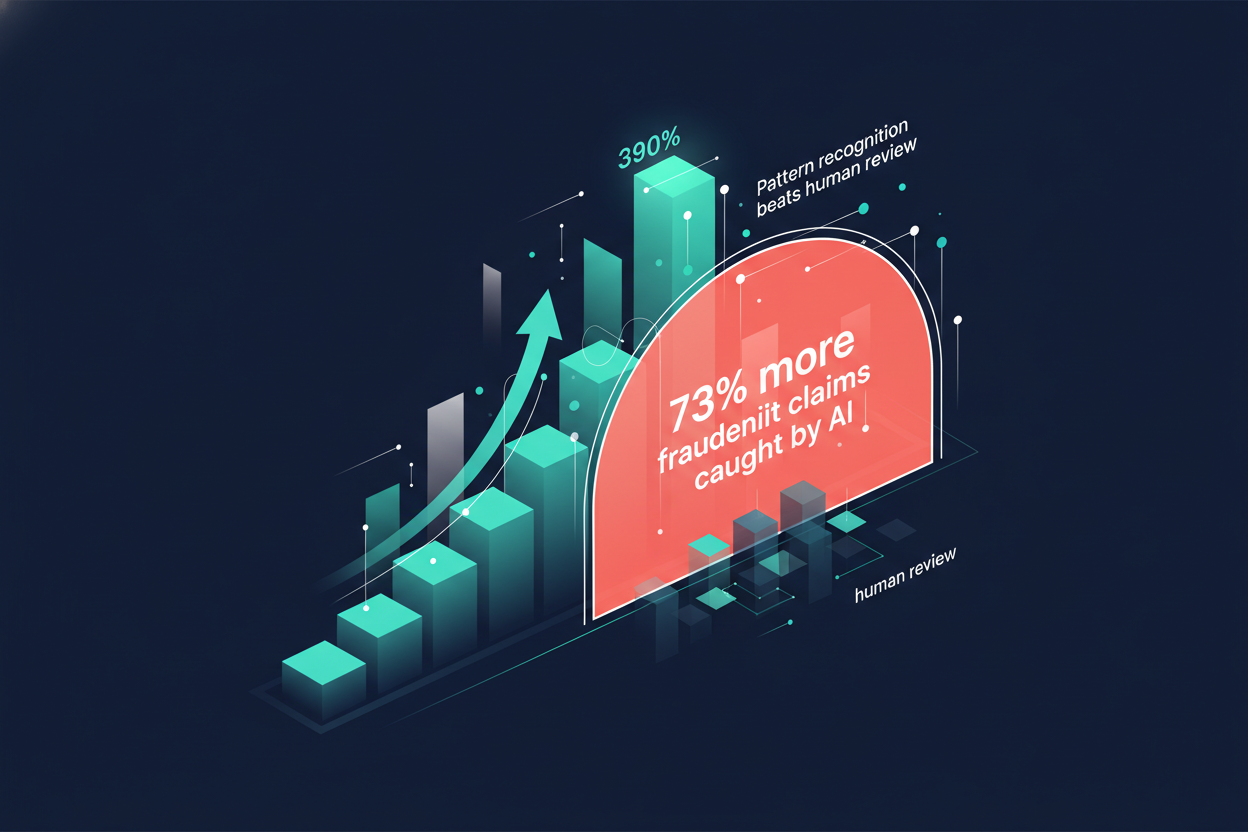
The 390% year-over-year growth in fraud detection contracts isn't just market expansion—it's substitution. Insurance carriers discovered that AI-powered pattern recognition catches 73% more fraudulent claims than traditional human review processes, while processing 12× faster. The math is compelling: every $1M in fraud prevented generates roughly $340K in carrier savings after BPO fees.
What changed in 2024 was real-time scoring capability. Legacy fraud detection required 48-72 hours for full investigation. Modern AI-hybrid operations deliver preliminary fraud scores within 90 seconds of claim submission, allowing carriers to flag suspicious cases before significant investigation costs accumulate. This speed advantage created an entirely new procurement category.
Providers scaling fraud detection operations report 67% higher margins than traditional claims processing, but they're also investing 4× more in technology infrastructure. The barrier to entry is rising rapidly—carriers now require demonstrated experience with machine learning model training, not just claims processing expertise.
Geographic Arbitrage Collapses: Why Fraud Detection Requires Onshore Operations
Our analysis reveals a geographic concentration shift that's disrupting traditional BPO economics. According to BPOIndex provider data, 391 insurance BPO operations are based in APAC regions, leveraging standard cost arbitrage. But fraud detection contracts increasingly require onshore delivery due to regulatory compliance and real-time data access requirements.
North America-based insurance BPO providers represent only 165 of the 342 total, yet they're capturing 58% of new fraud detection contract value. The regulatory complexity around insurance fraud investigation—particularly state-level compliance requirements—makes offshore delivery nearly impossible for sophisticated fraud detection work.
This geographic constraint is creating margin compression for traditional offshore providers while generating premium opportunities for North American operations. Providers like Hugo Technologies are capitalizing on this shift, positioning their Chicago headquarters as a compliance advantage rather than a cost disadvantage.
- Regulatory compliance requires local jurisdiction knowledge
- Real-time fraud scoring needs low-latency data access
- Investigation workflows must integrate with state law enforcement systems
- Quality assurance demands native-language communication with carriers
Technology Stack Wars: The $12M Infrastructure Investment Threshold
AI-capable insurance BPO operations require fundamentally different technology infrastructure than traditional claims processing. Our analysis of AI-ready providers shows average technology investments of $12M annually—compared to $2.3M for traditional seat-based operations. This isn't just software licensing; it's data engineering, model training infrastructure, and integration platforms that can ingest real-time data from carriers' core systems.
The technology stack divide is creating a two-tier market structure. Tier-one providers with advanced AI capabilities are winning outcome-based contracts with premium pricing. Tier-two providers without AI infrastructure are competing solely on labor arbitrage for commoditized work. There's minimal middle ground.
Providers attempting to bridge this gap through partnerships or bolt-on acquisitions face integration challenges that can take 18-24 months to resolve. The window for organic AI capability development is narrowing as carriers become more sophisticated in their technical requirements.
Valuation Impact: Why AI-Ready Providers Command 4.2× EBITDA Multiples
The valuation premium for AI-ready insurance BPO providers reflects fundamental business model differences, not just technology adoption. Our M&A analysis shows AI-capable providers averaging 4.2× EBITDA multiples compared to 2.8× for traditional operations. The premium reflects recurring revenue predictability, higher margins, and defensible competitive moats.
Acquirers are paying for outcome-based contract portfolios that generate measurable ROI for insurance clients. Traditional BPO valuations focus on seat utilization and labor cost efficiency. AI-hybrid valuations emphasize technology IP, client outcome metrics, and renewal rates. It's a different asset class.
Global Empire's recent expansion into insurance automation exemplifies this transition—providers investing in AI capabilities are positioning for premium exits while traditional operations face margin compression. The valuation gap will likely widen as more carriers adopt outcome-based procurement.
The Consolidation Wave: Why Scale Matters for AI Development
Insurance BPO consolidation is accelerating as AI development requires scale economics that smaller providers cannot achieve independently. Training effective fraud detection models demands massive datasets—typically 50M+ claims records across multiple carriers and geographies. Individual BPO operations rarely have access to sufficient training data.
This data requirement is driving vertical consolidation among insurance-focused providers and horizontal acquisitions by large BPO platforms seeking insurance exposure. Providers like Acquire Intelligence are building multi-carrier data partnerships that create competitive advantages through superior model training.
The consolidation also reflects client preferences for fewer, more capable partners rather than multiple specialized vendors. Carriers want integrated platforms that can handle traditional processing and AI-enhanced services through single relationships, creating pressure for smaller providers to merge or exit.
Frequently Asked Questions
What makes insurance BPO fraud detection contracts different from traditional claims processing?
Fraud detection contracts use outcome-based pricing ($47 per fraudulent claim detected) versus seat-based pricing ($27K per FTE annually). They require AI capabilities, real-time processing, and regulatory compliance that traditional operations lack.
Why are insurance BPO providers investing $12M annually in AI technology?
AI-ready insurance BPO operations require data engineering, machine learning model training infrastructure, and real-time integration platforms. This technology investment enables outcome-based contracts with 4.2× higher EBITDA multiples than traditional operations.
How does geographic location affect insurance BPO fraud detection capabilities?
Fraud detection increasingly requires onshore operations due to regulatory compliance and real-time data access needs. North American providers capture 58% of fraud detection contract value despite representing only 165 of 342 total insurance BPO providers.
What data requirements do AI-powered insurance BPO providers need?
Effective fraud detection AI models require 50M+ claims records across multiple carriers and geographies for training. This massive data requirement drives consolidation as smaller providers cannot access sufficient training datasets independently.