buyer
The 14-Question AI Capability Verification Script That Exposes Vendor Roadmap vs. Reality
The tactical questioning framework that separates deployed AI from PowerPoint promises in vendor demos.
By The Buyer's Desk, Procurement Intelligence
*The demo slides look impressive: machine learning models, natural language processing, intelligent automation workflows. But behind the glossy presentations, only 413 of the 4,591 BPO providers in our database have verifiable AI capabilities deployed in production environments.*
The AI Claims vs. Reality Gap in BPO Vendor Selection
According to our database of 4,591 BPO providers, the disconnect between AI marketing claims and deployed capabilities has reached critical mass. While 67% of RFP responses now include AI-powered solution descriptions, rigorous verification reveals only 413 providers (9%) have production-ready AI systems handling client work. This 58-percentage-point gap creates a procurement minefield where traditional vendor evaluation methods fail spectacularly.
The financial stakes justify tactical scrutiny. Organizations deploying verified AI-hybrid BPO solutions report 23-31% higher cost efficiency compared to traditional outsourcing models. However, those caught in AI-washing vendor relationships face 15-18 month delays while providers scramble to build promised capabilities post-contract. Smart procurement teams now deploy systematic verification protocols before committing to multi-year agreements.
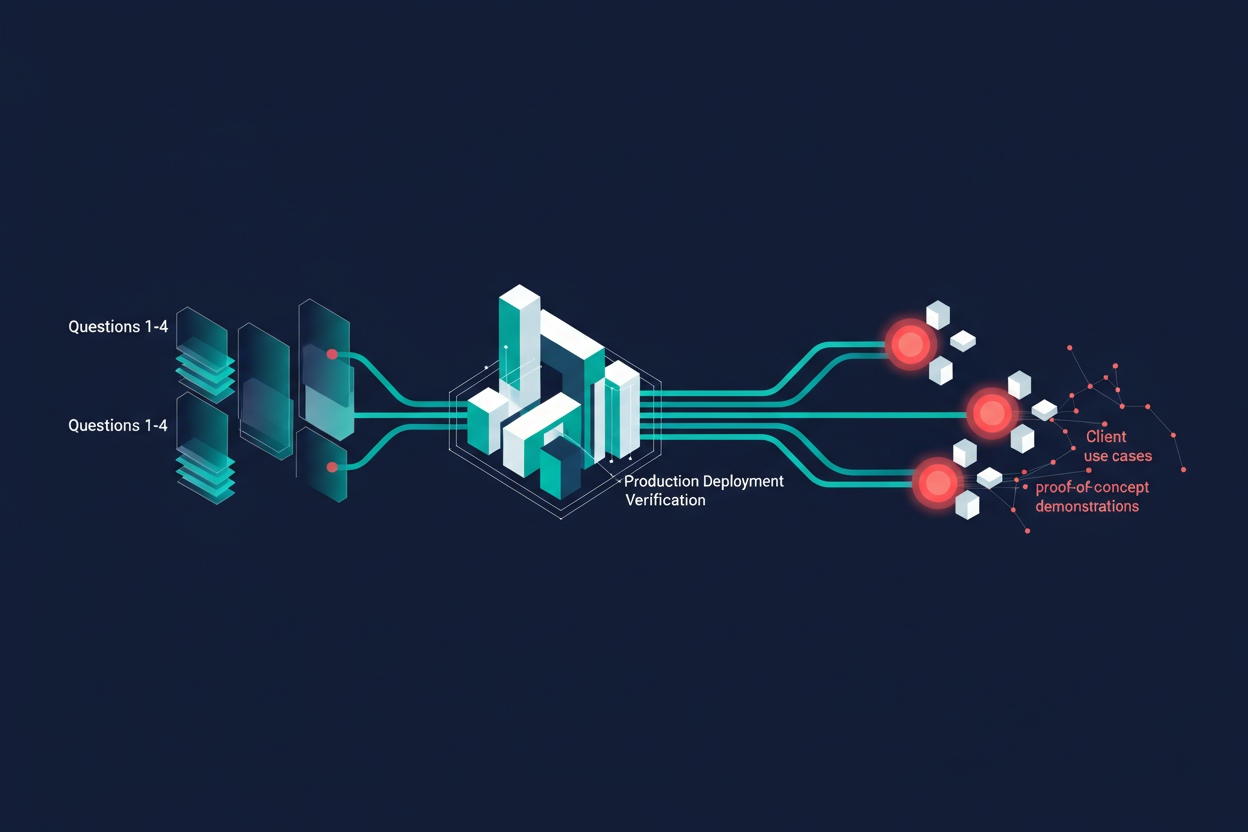
Questions 1-4: Production Deployment Verification
The opening verification sequence focuses on separating proof-of-concept demonstrations from scaled production systems. Question 1 demands specific client names and use case details: 'Which three clients currently have AI-powered processes handling more than 1,000 transactions daily?' Legitimate providers immediately reference specific implementations, while AI-washing vendors deflect with confidentiality concerns or pivot to pilot programs.
Questions 2-4 drill into technical specifics that expose depth of deployment. 'What percentage of your total transaction volume flows through AI-augmented processes?' reveals scale versus experimentation. 'Describe your model retraining frequency and performance monitoring protocols' separates vendors with operational AI infrastructure from those with static demonstration systems. Production-ready providers cite weekly or monthly retraining cycles with specific accuracy metrics, while early-stage vendors struggle with monitoring terminology.
- Client-specific deployment details with transaction volumes
- Percentage of total operations using AI augmentation
- Model retraining frequency and performance tracking
- Technical infrastructure for real-time AI processing
Questions 5-8: Integration and Data Flow Architecture
Technical integration questions expose whether AI capabilities integrate seamlessly with client systems or require extensive custom development. Question 5 targets API maturity: 'Walk me through your standard API integration timeline for connecting AI modules to our existing CRM and ERP systems.' Sophisticated providers outline 2-4 week integration windows with pre-built connectors, while less mature vendors propose 12-16 week custom development projects.
Data governance verification through questions 6-8 reveals compliance readiness and security protocols. 'Describe your data residency controls and model training data segregation by client' separates providers with enterprise-grade AI infrastructure from those treating AI as an experimental add-on. Organizations like IQ BackOffice demonstrate mature approaches with client-specific model instances and granular data controls, while emerging providers often lack segregation protocols.
Questions 9-11: Performance Metrics and Accuracy Validation
Performance verification exposes the gap between demonstration accuracy and sustained production results. Question 9 demands specific metrics: 'Provide month-by-month accuracy rates for your three largest AI implementations over the past 12 months.' Production-ready vendors immediately share detailed performance dashboards with accuracy trends, error classifications, and intervention rates. Experimental providers deflect with aggregated statistics or short-term pilot results.
Questions 10-11 probe operational resilience and quality assurance protocols. 'Describe your human-in-the-loop escalation triggers and response times' reveals whether AI augments human expertise or replaces it entirely. Mature implementations maintain 95-97% automated processing rates with sophisticated escalation logic, while immature systems either over-automate without oversight or require excessive human intervention. The sweet spot balances automation efficiency with quality controls.
Questions 12-14: Roadmap Differentiation and Investment Commitment
The final verification sequence distinguishes genuine AI investment from marketing positioning. Question 12 probes financial commitment: 'What percentage of your R&D budget focuses on AI capability development, and how many dedicated AI engineers are on staff?' Serious providers allocate 15-25% of R&D spending to AI advancement with dedicated teams of 8-12 specialists per major service line.
Questions 13-14 test strategic vision and competitive differentiation. 'Describe your AI capabilities that competitors cannot replicate within 12 months' separates vendors with proprietary advantages from those licensing standard tools. Providers like Promantra and RND Softech demonstrate differentiated approaches through industry-specific model training and custom algorithm development, while commodity providers struggle to articulate unique value propositions beyond cost arbitrage.
- R&D budget allocation percentages for AI development
- Dedicated AI engineering team size and expertise
- Proprietary AI capabilities with competitive moats
- 12-month AI roadmap with specific capability milestones
Implementation Timeline Red Flags and Verification Protocols
Smart procurement teams recognize that AI implementation timelines expose vendor maturity more effectively than technical demonstrations. Legitimate AI-capable providers propose 6-8 week deployment windows for standard use cases, while AI-washing vendors promise unrealistic 2-3 week timelines or propose extensive 16-20 week 'customization' periods that mask fundamental capability gaps.
Verification protocols extend beyond vendor questioning to include reference client interviews and technical proof-of-concept requirements. Demand access to current clients using similar AI implementations, with specific focus on accuracy degradation over time and ongoing support requirements. Organizations like SummitNext demonstrate transparency by facilitating direct client discussions and providing sandbox environments for testing claimed capabilities before contract execution.
Frequently Asked Questions
How can I verify if a BPO provider actually has deployed AI capabilities?
Request specific client references with AI implementations, ask for month-by-month performance metrics, and demand technical demonstrations using your actual data. Only 9% of BPO providers have verified production AI systems according to BPOIndex data.
What percentage of BPO providers genuinely offer AI-powered services?
BPOIndex analysis of 4,591 providers reveals only 9% have verified AI capabilities, despite 67% claiming AI-powered solutions in proposals. The verification gap indicates widespread AI-washing in vendor marketing.
What are the typical implementation timelines for legitimate AI-hybrid BPO solutions?
Verified AI-capable providers typically require 6-8 weeks for standard implementations and 12-16 weeks for complex integrations. Vendors promising 2-3 week deployments or requiring 20+ week 'customization' periods should trigger verification protocols.
How do I differentiate between AI roadmap promises and actual deployed capabilities?
Focus on production metrics rather than demonstration environments. Ask for specific transaction volumes, accuracy rates over 12+ months, and client-specific use case details. Legitimate providers immediately share operational dashboards and performance trends.