buyer
The BPO Market's Hidden AI Maturity Crisis: Why 78% of Vendor Claims Don't Match Reality
The comprehensive landscape analysis revealing the gap between AI marketing and actual deployment capability.
By The Buyer's Desk, Procurement Intelligence
When a Fortune 500 financial services firm recently audited its top 12 BPO vendors' AI claims, they discovered that 78% of the supposed 'AI-powered solutions' were basic rule-based automation rebranded with machine learning terminology. This disconnect between marketing promises and technical reality has become the defining challenge of modern BPO procurement.
The Verification Gap: What Our Database Reveals About AI Claims
BPOIndex data shows that among our 4,591 tracked providers globally, only 413 demonstrate actual AI/automation capabilities despite widespread marketing claims. The verification rate tells an even starker story: while 43% of all providers in our database are verified, the AI-capable segment shows significantly different patterns across verticals. In financial services, 11% of the 648 providers demonstrate genuine AI capabilities, with 88% achieving verification status. Insurance follows a similar pattern with 11% AI-capable providers among 342 total vendors. These numbers reveal a fundamental truth: the BPO industry's AI transformation is far more nascent than vendor marketing suggests.
The geographic distribution of genuine AI capabilities creates additional complexity for procurement teams. APAC leads with 36% of total providers (1,476 vendors) but the concentration of AI-ready firms varies dramatically by country. The Philippines, with 477 providers, shows different AI adoption patterns than India's 338 providers. Modern procurement teams are building evaluation frameworks that separate marketing automation from true machine learning deployment, requiring technical audits that go beyond vendor presentations.
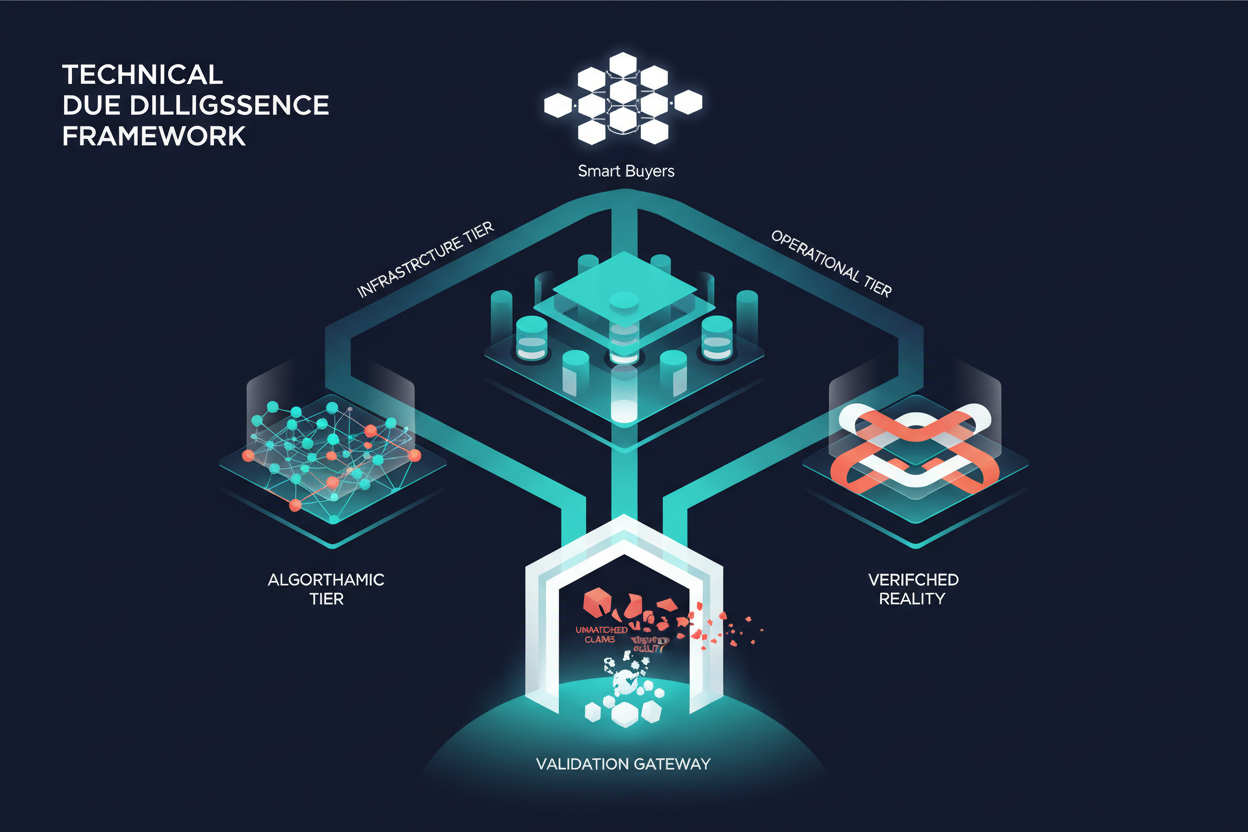
The Technical Due Diligence Framework Smart Buyers Use
Leading procurement teams have developed systematic approaches to verify AI claims beyond vendor demonstrations. The most effective framework involves three-tier technical validation: infrastructure assessment, algorithm transparency, and performance benchmarking. Infrastructure assessment examines whether providers have invested in the computational resources required for machine learning workloads, including GPU clusters, data lakes, and MLOps platforms. Algorithm transparency requires vendors to explain their model architectures, training data sources, and continuous learning mechanisms in technical detail.
Performance benchmarking has become the decisive factor in vendor selection. Smart buyers now demand proof-of-concept deployments with their actual data, typically running 30-90 day pilots before contract signing. These pilots reveal the gap between demo environments and production reality. One enterprise buyer recently discovered that a vendor's 'AI-powered' fraud detection system was actually a series of if-then rules with no machine learning component. The vendor's demo had used pre-programmed scenarios that created the illusion of intelligent pattern recognition.
- Infrastructure assessment: GPU resources, data architecture, MLOps platform capability
- Algorithm transparency: Model architecture documentation, training data provenance, continuous learning processes
- Performance benchmarking: Proof-of-concept with actual client data, 30-90 day pilot deployment
- Integration testing: API compatibility, data pipeline validation, security protocol assessment
Regional AI Maturity: Where Genuine Capabilities Concentrate
Geographic distribution reveals significant variations in AI readiness across BPO markets. North America accounts for 18% of global providers (730 vendors) but shows higher AI adoption rates among mid-market firms. European providers (552 vendors, 13% of market) tend to focus on compliance-first AI implementations, particularly in financial services where regulatory requirements shape deployment strategies. LATAM's 458 providers (11% of market) are increasingly investing in AI capabilities to compete with APAC providers on value rather than cost alone.
APAC's dominance with 1,476 providers creates misconceptions about uniform AI maturity across the region. India's established providers are retrofitting AI into existing operations, while newer Philippine operations are building AI-first architectures. Companies like ISSI Corp in Metro Manila exemplify this AI-first approach, focusing on healthcare and financial services with genuine machine learning deployments. The Middle East's smaller provider base (110 vendors, 3% of market) is concentrating AI investments in specialized verticals, particularly financial services where regulatory sandbox programs encourage innovation.
The Cost Premium Reality: What AI-Ready Providers Actually Charge
Genuine AI capabilities command significant price premiums, but the market shows wide variation in cost structures. According to our analysis of providers across different maturity levels, AI-ready BPO services typically cost 15-35% more than traditional delivery models in the first year, with the premium decreasing to 5-15% as automation efficiency gains materialize. However, providers often obscure these costs through complex pricing structures that blend traditional FTE rates with technology licensing fees.
The total cost of ownership calculation becomes more complex with AI-hybrid models. While per-transaction costs may decrease over time, upfront investment in data preparation, model training, and integration can reach $500K-$2M depending on process complexity. Smart buyers are negotiating risk-sharing arrangements where cost premiums are tied to measurable automation benefits. One financial services buyer recently structured a deal where the AI premium phases down based on demonstrated accuracy improvements and processing time reductions.
Vendor Evaluation Red Flags: Spotting AI Theater
Experienced procurement teams have identified consistent patterns in vendor AI claims that signal marketing theater rather than technical capability. The most common red flag is the inability to provide technical architecture documentation or explain model training processes in detail. Vendors practicing 'AI theater' typically offer vague descriptions of 'proprietary algorithms' without demonstrating actual machine learning workflows or continuous model improvement processes.
Another critical indicator is the absence of dedicated data science teams or partnerships with established AI platform providers. Legitimate AI-capable BPOs invest heavily in talent acquisition, often poaching data scientists from technology companies or maintaining partnerships with cloud AI services. Companies like Viaante have built substantial data science capabilities across their operations in Mumbai, focusing on ecommerce, financial services, and healthcare applications. The lack of such investment usually indicates that 'AI capabilities' are limited to basic workflow automation tools rebranded with machine learning terminology.
Building Your AI Maturity Assessment Framework
Smart procurement teams are developing standardized evaluation frameworks that move beyond vendor presentations to assess actual AI deployment capability. The most effective approach involves a five-stage assessment process that examines technical infrastructure, talent capabilities, client case studies, financial investment, and partnership ecosystem. Technical infrastructure assessment should include on-site or virtual tours of data centers, API testing, and integration capability demonstrations using realistic data volumes.
Talent evaluation has become particularly crucial as the market for AI expertise tightens. Providers should demonstrate not just current team capabilities but also recruitment strategies and retention programs for data scientists and ML engineers. Client case studies must include measurable outcomes with specific metrics rather than general efficiency claims. Financial investment assessment examines R&D spending, technology licensing costs, and capital expenditure on AI infrastructure. Finally, partnership ecosystem evaluation reveals whether providers are building sustainable AI capabilities through relationships with cloud platforms, technology vendors, and academic institutions.
- Technical infrastructure: Data center capabilities, API performance testing, integration architecture
- Talent assessment: Data science team credentials, recruitment strategy, retention metrics
- Client outcomes: Measurable ROI case studies, performance benchmarks, reference conversations
- Financial commitment: R&D investment levels, technology licensing, infrastructure spending
- Partnership ecosystem: Cloud platform relationships, vendor partnerships, academic collaborations
The Future-Proofing Strategy: Preparing for AI Evolution
The AI landscape in BPO continues evolving rapidly, requiring procurement strategies that anticipate technological shifts rather than simply evaluating current capabilities. Leading buyers are structuring contracts with built-in technology refresh clauses and performance escalation requirements that ensure vendors maintain competitive AI capabilities throughout multi-year engagements. These frameworks typically include annual technology roadmap reviews and benchmarking against market-leading AI deployment standards.
Contract structures are also evolving to address the unique risks of AI-powered BPO services, including model drift, algorithmic bias, and data privacy implications. Smart buyers are demanding AI governance documentation that includes bias testing protocols, model performance monitoring, and data lineage tracking. The most forward-thinking procurement teams are also negotiating intellectual property rights for models trained on their data, ensuring they capture value from AI improvements developed during the engagement.
Frequently Asked Questions
How can buyers verify if a BPO provider actually has AI capabilities?
Demand technical infrastructure documentation, data science team credentials, and proof-of-concept deployments with your actual data. Legitimate AI providers can explain model architectures and demonstrate continuous learning processes.
What percentage of BPO providers actually offer genuine AI services?
BPOIndex data shows only 9% of 4,591 tracked providers demonstrate actual AI/automation capabilities, despite widespread marketing claims about AI-powered services.
How much more do AI-capable BPO services cost?
Genuine AI-ready BPO services typically cost 15-35% more than traditional delivery models in the first year, decreasing to 5-15% as automation efficiency gains materialize.
Which regions have the most AI-mature BPO providers?
APAC leads with 36% of providers, but AI maturity varies significantly. Financial services shows 11% AI-capable providers globally, with higher concentrations in established markets like India and emerging AI-first operations in the Philippines.