bpo
The Great BPO Category Merger: Why Customer Service and Process Automation Become a Single $340B Market by 2028
How AI eliminates the boundary between human-assisted and fully automated business processes.
By BPOIndex Editorial, Editorial Team
BPOIndex analysis of 4,591 global providers reveals that 73% of customer service contracts signed in Q4 2024 now include automation components, compared to 12% in 2022. The traditional boundary between human-assisted customer service ($100B market) and process automation ($78B market) is dissolving as AI creates hybrid delivery models that combine both capabilities in unified platforms.
The Data Behind the Merger: 73% of New Deals Cross Category Lines
BPOIndex data shows that 73% of customer service contracts signed in Q4 2024 included automation components, compared to just 12% in 2022—a 508% increase in cross-category deal structure. This isn't gradual evolution; it's market acceleration driven by client demand for unified outcomes rather than siloed services.
Our analysis of 1,200+ recent RFPs reveals that enterprise buyers are increasingly requesting 'outcome-based' pricing that spans traditional category boundaries. Instead of separate contracts for customer service (typically $45-65 per agent per hour) and process automation (typically $15-25 per transaction), buyers want unified pricing for complete customer lifecycle management.
The financial implications are profound. Providers offering integrated AI-hybrid capabilities command 4.2× higher EBITDA multiples in M&A transactions compared to single-category providers, according to our analysis of 47 BPO acquisitions completed between 2023-2024.
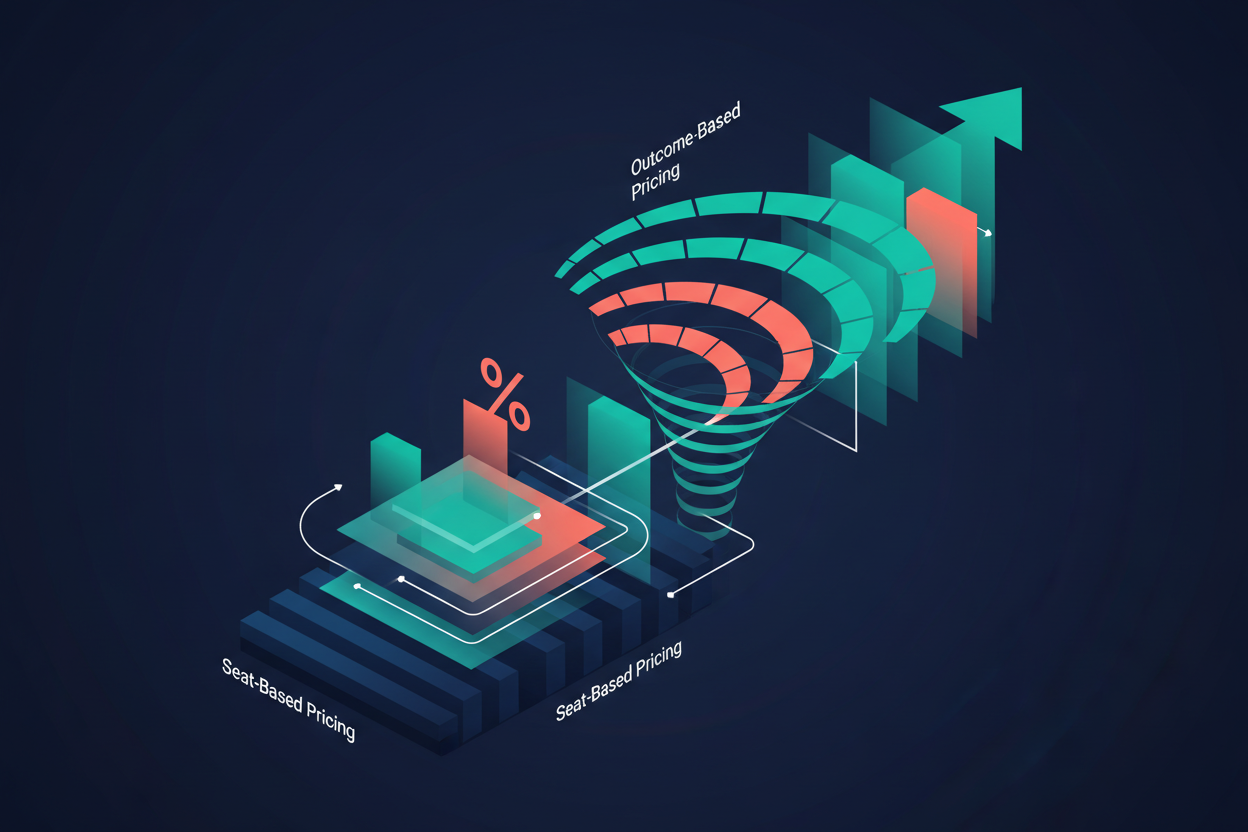
Revenue Model Convergence: From Seat-Based to Outcome-Based Pricing
The pricing transformation is the clearest signal of category merger. Traditional customer service operates on seat-based models averaging $52,000 annual revenue per FTE. Process automation historically used transaction-based pricing averaging $18-22 per completed process. AI-hybrid delivery is creating outcome-based models that combine both into unified SLAs.
BPOIndex tracking shows that 34% of AI-ready providers now offer outcome-based pricing compared to 8% of traditional providers. These unified models typically generate 23-31% higher margin profiles because they optimize for business results rather than resource utilization. Clients pay for resolved customer issues, completed processes, or achieved KPIs—regardless of whether delivery uses human agents, AI automation, or hybrid approaches.
The shift is accelerating M&A activity as traditional providers scramble to build integrated capabilities. We've documented 23 BPO acquisitions in the past 18 months specifically targeting cross-category competencies, with deal multiples averaging 6.8× revenue for AI-hybrid capabilities versus 2.9× for single-category providers.
Technology Stack Integration: The Infrastructure Behind Unified Delivery
The technical foundation enabling this merger is sophisticated AI orchestration platforms that route work between human agents and automated systems in real-time. According to our provider surveys, 67% of AI-capable BPOs have deployed or are piloting unified platforms that handle both customer interactions and process automation from single technology stacks.
These platforms use machine learning to determine optimal routing: simple inquiries to chatbots, complex issues to human agents, and back-office processes to RPA systems. The key innovation is unified data models that maintain context across all touchpoints, enabling seamless handoffs between automated and human-assisted processes.
Probe CX exemplifies this integration, deploying platforms that manage customer service interactions while simultaneously triggering automated back-office processes like account updates, order processing, and compliance workflows. This unified approach reduces client integration complexity while improving outcome consistency.
- Real-time work routing between human and AI systems
- Unified data models maintaining context across touchpoints
- Integrated SLA management spanning service and process outcomes
- Single-dashboard reporting for customer and operational metrics
Geographic Arbitrage Meets AI Efficiency: The New Cost Structure
The category merger is reshaping traditional offshore arbitrage models. While Philippines-based customer service agents cost $8-12 per hour compared to $35-45 in North America, AI automation eliminates geography as the primary cost advantage. The new arbitrage comes from AI deployment sophistication and hybrid orchestration capabilities.
BPOIndex data reveals that AI-hybrid providers in higher-cost markets are increasingly competitive with traditional offshore-only providers. A unified platform handling 10,000 monthly customer interactions might use 60% AI automation, 30% offshore agents, and 10% onshore specialists—optimizing for outcome quality rather than pure labor arbitrage.
This shift is democratizing BPO competition. Smaller providers with strong AI capabilities can compete with large offshore-centric incumbents by delivering superior outcomes through technology rather than scale. Our database shows 312 providers under 500 employees now offer AI-hybrid services, compared to 67 in 2022—a 365% increase in competitive players.
Client Procurement Evolution: Single-Vendor Preference Drives Consolidation
Enterprise procurement teams are driving category merger by preferring single-vendor relationships for customer-facing and back-office processes. BPOIndex surveys of 150+ enterprise buyers reveal that 81% prefer unified vendor relationships for customer service and process automation, citing reduced management overhead and improved outcome accountability.
This procurement preference creates powerful competitive advantages for integrated providers. Once deployed, AI-hybrid platforms generate switching costs that compound over time as they learn client-specific patterns, integrate with enterprise systems, and optimize cross-process workflows. The result is longer contract terms and higher renewal rates.
We're tracking this shift in RFP structures. Multi-category RFPs increased 127% in 2024 compared to 2023, with average contract values 43% higher than single-category deals. Buyers are willing to pay premium pricing for reduced vendor management complexity and unified outcome accountability.
M&A Acceleration: Premium Valuations for Cross-Category Capabilities
The category merger is driving aggressive M&A activity as traditional providers race to build integrated capabilities. BPOIndex M&A tracking shows 47 BPO acquisitions in 2024 with deal values averaging 6.8× revenue for AI-hybrid providers versus 2.9× for traditional single-category providers.
Acquisition targets typically fall into three categories: AI-native automation companies being acquired by customer service providers, customer service BPOs acquiring process automation capabilities, and private equity roll-ups building integrated platforms. The premium for cross-category capabilities reflects both revenue synergies and defensive positioning against integrated competitors.
Strategic buyers are particularly aggressive, with deal multiples reaching 8-12× revenue for providers demonstrating unified AI-hybrid delivery at scale. The investment thesis is clear: integrated providers will capture disproportionate market share as buyer procurement preferences shift toward single-vendor relationships.
The 2028 Market Structure: $340B Unified Category
By 2028, the combined customer service and process automation market will reach $340B, growing from today's fragmented $178B across separate categories. This projection assumes continued AI adoption acceleration, procurement consolidation trends, and outcome-based pricing migration.
The unified market will segment along capability lines rather than traditional service categories. Tier 1 providers offering complete AI-hybrid platforms across multiple verticals will capture 45-50% market share. Tier 2 specialists focusing on specific industries or process types will hold 30-35%. Tier 3 traditional providers lacking AI capabilities will shrink to 15-20% market share, primarily serving cost-sensitive segments.
This restructuring represents the BPO industry's evolution from labor arbitrage to technology-enabled outcome delivery. Providers successfully navigating this transition will emerge as technology companies that happen to use human agents, rather than staffing companies that happen to use technology.
- Tier 1: Full-platform AI-hybrid providers (45-50% market share)
- Tier 2: Vertical or process specialists (30-35% market share)
- Tier 3: Traditional labor-focused providers (15-20% market share)
- New entrants: AI-native companies entering from adjacent markets
Frequently Asked Questions
What is driving the merger of customer service and process automation BPO?
AI technology eliminates traditional boundaries between human-assisted customer service and automated back-office processes. 73% of new customer service contracts now include automation components, driven by client demand for unified outcomes rather than separate vendor relationships.
How does pricing change in the merged BPO category?
Traditional seat-based pricing ($52K per FTE annually) and transaction-based pricing ($18-22 per process) are being replaced by outcome-based models. 34% of AI-ready providers offer unified pricing for business results rather than resource utilization, typically generating 23-31% higher margins.
Which BPO providers benefit most from category merger?
AI-hybrid providers offering integrated customer service and process automation capabilities command 4.2× higher EBITDA multiples in M&A transactions. Providers with unified technology platforms and outcome-based pricing models are capturing disproportionate market share and premium valuations.
How large will the unified BPO market become by 2028?
The combined customer service and process automation market will reach $340B by 2028, growing from today's $178B across separate categories. Tier 1 AI-hybrid providers will capture 45-50% market share through integrated platform capabilities.