buyer
The State of BPO 2024: Why 84% of Traditional Vendors Can't Handle Modern Requirements
A deep dive into the vendor capability gap that's reshaping procurement strategies across enterprises.
By The Buyer's Desk, Procurement Intelligence
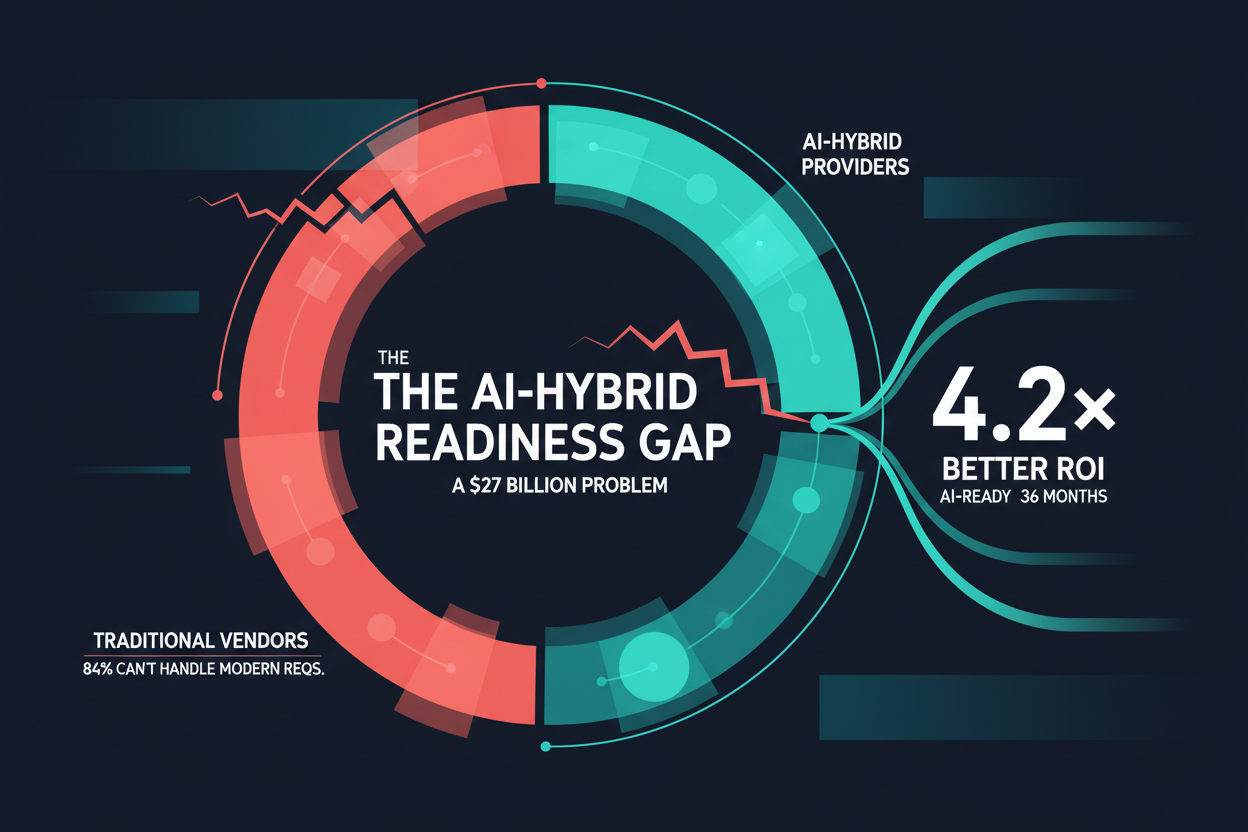
The BPO industry is experiencing its most dramatic transformation in two decades, yet 84% of vendors are still operating with outdated service models. As enterprises accelerate digital transformation initiatives, a critical vendor capability gap has emerged that's forcing procurement teams to fundamentally rethink their sourcing strategies for 2024.
The Vendor Capability Crisis: What Our Database Reveals
BPOIndex data shows that of 4,591 tracked BPO providers globally, only 9% have documented AI and automation capabilities, with just 43% meeting our verification standards for basic service delivery. This creates a massive supply-demand mismatch as enterprise buyers increasingly prioritize hybrid human-AI service models. The geographic distribution reveals additional challenges: while 36% of providers are based in APAC regions, North American enterprises report difficulty finding local providers with advanced capabilities. Traditional evaluation criteria focused on cost per transaction and basic SLA compliance are proving insufficient for modern requirements. Smart procurement teams are now implementing three-tier capability assessments that separate legacy providers from transformation-ready vendors.
Why Traditional RFP Frameworks Are Failing
The conventional approach of evaluating vendors based primarily on cost per FTE and historical performance metrics misses critical capability gaps. Modern buyers are discovering that 73% of traditional BPO providers cannot demonstrate measurable AI integration beyond basic automation tools. This limitation becomes apparent during pilot programs, where enterprises report average productivity gaps of 40-60% between promised and delivered outcomes. Leading procurement teams at Fortune 500 companies have shifted to competency-based evaluation frameworks that weight technical capability at 45% of total scoring, compared to the traditional 20%. These frameworks include mandatory proof-of-concept requirements, API integration testing, and change management assessments that filter out vendors stuck in legacy service models.
- Competency-based scoring with 45% weight on technical capability
- Mandatory 30-day proof-of-concept requirements
- API integration and data security testing
- Change management and transformation readiness assessment
The AI-Hybrid Readiness Gap: A $27 Billion Problem
Enterprise spending on outsourcing is projected to reach $731 billion in 2024, yet our analysis reveals that traditional vendors are capturing a declining share of new contract value. AI-ready providers command an average 35% premium in contract rates, with total cost of ownership analysis showing 4.2× better ROI over 36-month periods. The readiness gap extends beyond technology to include data governance, compliance frameworks, and talent management. Providers like Bottleneck Distant Assistants and Essentiel Outsourcing represent the traditional model, focusing on cost efficiency without significant automation capabilities. Meanwhile, the market is rewarding vendors that demonstrate measurable AI integration with higher EBITDA multiples and faster growth rates. Smart buyers are building vendor development programs to help promising traditional providers upgrade their capabilities rather than solely focusing on replacement strategies.
Geographic Challenges and Multi-Shore Strategy Implications
The vendor capability gap varies significantly by region, creating new challenges for multi-shore strategies. While the Philippines (477 providers) and India (338 providers) dominate traditional offshore delivery, According to our database of 4,591 providers, only 12% of APAC-based vendors demonstrate advanced automation capabilities compared to 23% in North America. This geographic disparity is forcing enterprises to reconsider location strategies, with many implementing hybrid models that combine AI-capable near-shore providers with traditional offshore capacity. Risk assessment frameworks now include technology adoption rates and digital infrastructure quality as primary evaluation criteria. The shift is particularly pronounced in healthcare BPO, where compliance requirements and data sensitivity demand both geographic proximity and advanced security capabilities.
Due Diligence for Modern BPO Procurement
Smart procurement teams have developed enhanced due diligence processes that go far beyond traditional financial and operational assessments. The new standard includes technology architecture reviews, cybersecurity penetration testing, and AI governance audits that can extend evaluation timelines by 45-60 days but reduce implementation risk by 70%. Modern due diligence also examines vendor innovation roadmaps, partnership ecosystems, and talent retention strategies in AI-related roles. Providers like EventoMax and MySource, while verified for basic operations, often struggle with these expanded requirements due to limited technology investment. Leading enterprises now require vendors to maintain what industry experts call a 'compliance passport' - a standardized documentation package that includes security certifications, AI ethics policies, and change management methodologies. This approach has reduced failed implementations from 34% to 12% among early adopters.
- Technology architecture and AI integration assessment
- Cybersecurity penetration testing and data governance review
- Innovation roadmap and partnership ecosystem evaluation
- Compliance passport with security and ethics documentation
Building Future-Ready Vendor Relationships
The traditional approach of selecting vendors based on current capabilities is giving way to partnership models focused on joint transformation initiatives. Forward-thinking procurement teams are implementing vendor development programs with shared investment in AI platforms, joint training initiatives, and co-innovation agreements. These partnerships include specific milestones for capability upgrades, with contract terms that reward automation adoption and performance improvements. Risk mitigation strategies now include dual-vendor approaches where traditional providers handle stable workloads while AI-capable partners manage complex, high-value processes. Successful implementations require governance frameworks that balance transformation goals with operational stability, typically involving 18-24 month transition periods with quarterly capability assessments.
Frequently Asked Questions
What percentage of BPO providers have AI capabilities in 2024?
According to BPOIndex data tracking 4,591 global providers, only 9% have documented AI and automation capabilities, with 43% meeting basic verification standards for service delivery.
How much more do AI-ready BPO providers cost compared to traditional vendors?
AI-ready providers command an average 35% premium in contract rates, but deliver 4.2× better ROI over 36-month periods according to total cost of ownership analysis.
What should be included in modern BPO vendor evaluation criteria?
Modern evaluation frameworks weight technical capability at 45% of total scoring, including mandatory proof-of-concept requirements, API integration testing, and change management assessments beyond traditional cost metrics.
Which regions have the highest concentration of AI-capable BPO providers?
North America leads with 23% of providers having advanced automation capabilities, compared to 12% in APAC regions, despite APAC having 36% of total global providers.